Wuthering Waves continues to build upon the lore of the game with each major update, and one recurring entity appears to be central to nearly every consequential disaster that occurs by version 3.2. If you are attempting to comprehend who or what Threnodians are in Wuthering Waves, this is a significant topic for the overall understanding of the game (as they appear to be more than flashy boss fights or random calamities) since they form the basis of the most philosophical and existential conflicts present in the game.
The Origins of Threnodians - In their most basic form, Threnodians have represented physical embodiments of all the darkness of the human race (though usually not through artificial means) and are not generally simple invaders or anything that arrived from outside of a civilization. They are shaped by the fear of the human race, specifically through the level of trauma and despair as well as by the destructive impulses that are found deep within the unconscious of all people on Solaris-III.
In one way or another, their creation has been tied inextricably to the event referred to as The Lament; which serves as both an ignition point and an ongoing source of the negative resonant force causing their creation.
What's particularly intriguing about Threnodians, however, is that they do not merely represent evil in a general sense but incorporate a specific distorted human experience. This is the basic premise that defines the entire category. If generations of individuals are molded by conflict, forced integration, or anxiety of disappearing, then these sentiments and notions may eventually crystallize into something that utilizes that idea against civilization itself. In a very literal way, Threnodians are humanity's greatest wounds brought into form, given a voice, and possess an utterly ridiculous amount of ability to destroy.
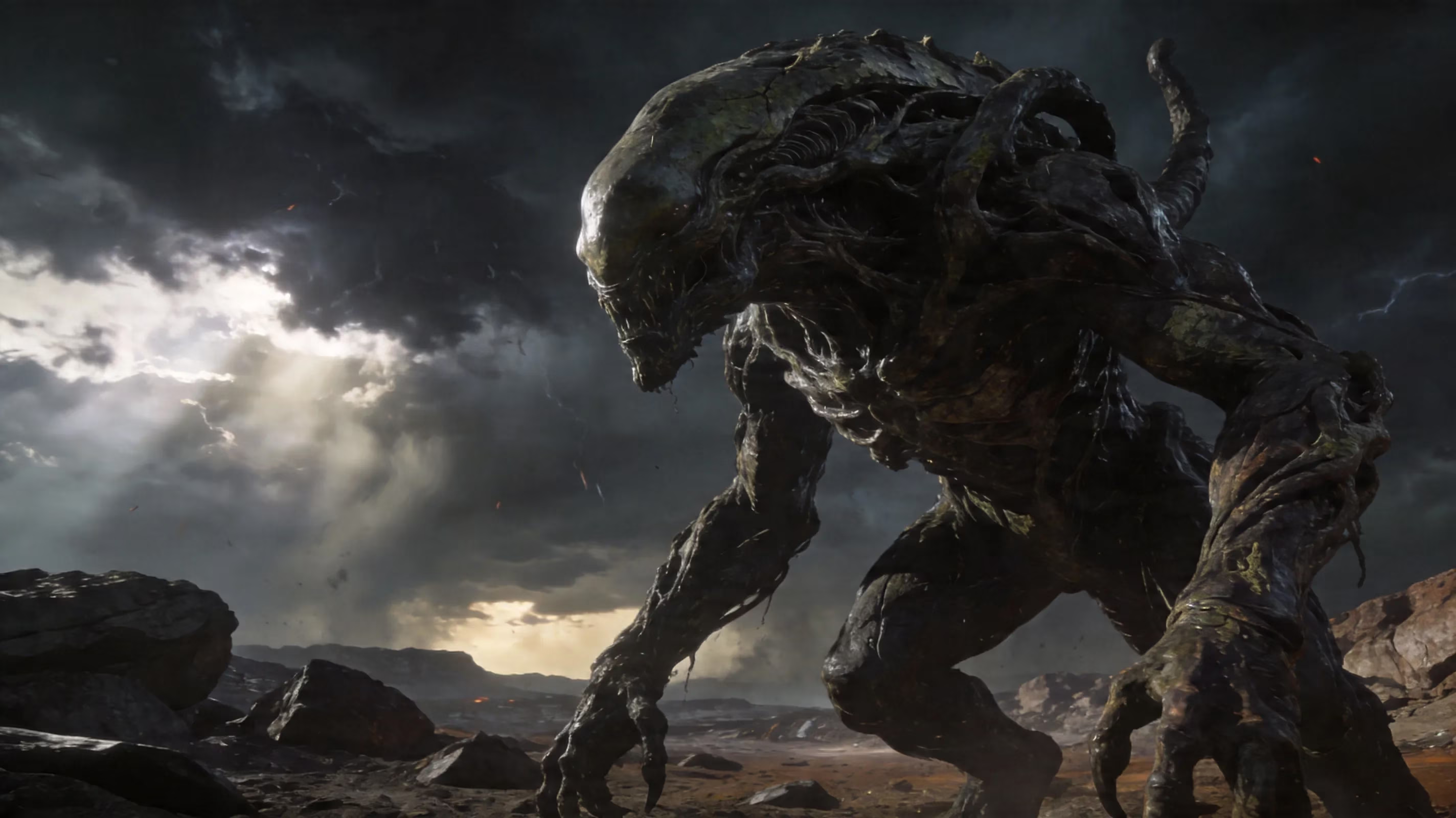
On the threat scale they are equivalent to the Sentinels, the enormous divine entities that watch over each of the regions on Solaris-III. This puts them well above a standard Tacet Discord as well as the overwhelming majority of calamity-class enemies. When a Threnodian attacks an area, they do not merely assault it and move on. Their mere presence causes local Waveworn phenomena to be thrown into distortion, disaster to become more catastrophic, and the surrounding land's natural resonance to be consumed by corruption. Just by being an existent entity, Threnodians are a destabilizing factor in civilization.
Threnodian Traits and Lore Rules
There is no random aspect to how the conceptual embodiment system of Threnodians works; instead, it corresponds directly to the experiences of the people who live in an area. An area with repeated warfare will result in the emergence of a war-like Threnodian. A society that enforces belief systems/conformity/collective identity will create a Threnodian with unifying characteristics. Because of this, the story of Threnodians is extremely dark because their existence is directly related to the history of civilization, they have their roots in the most horrible periods in civilization's history.
The association between Threnodians and Waveworn phenomena is one of the easiest ways to identify that a Threnodian is present. The Void Storms, Dark Tides and other large-scale disasters are not merely environmental anomalies occurring independently of one another. They are frequently enhanced, or are directly associated with, the awakened state or influence of a single Threnodian. Therefore, when a region begins to collapse under the weight of these phenomena, the core problem is often deeper than the storm. To achieve any long-lasting stability you must deal with the Threnodian at its source.
Then there are the Fractsidus, who have spent Chapters 1 - 3.2 working to demonstrate that they are more than willing to take advantage of this situation. As one of the primary antagonistical factions in the game, they are seeking to wake up and use Threnodians as weapons. Their philosophy views another large scale Lament event as a necessary evolution for humanity and a sort of vicious reset for civilization. In their mind, destruction is cleansing. Therefore, the Rover's conflict with the Fractsidus is inextricably intertwined with the Threnodian dilemma, because they are attempting to speed up exactly the type of apocalypse that everyone else is fighting to prevent.
However, there is one significant exception to the typical lore rule, and that is Aleph-1. Unlike the other Threnodians, Aleph-1 does not originate from the collective human psyche of Solaris-III. Its presence implies that the Threnodian classification might be larger than we originally thought and may include void-aligned beings from outside of the planet as well.
Named Threnodians in Wuthering Waves
As of Version 3.2, the main narrative has validated the existence of three Threnodians. Each Threnodian acts as an anchor for a major chapter conflict and each represents another type of corrupted concept. | Threnodian | Central Theme | Geography | Plot Point | |---|---|---|---| | Ovathrax | War | Jinzhou | Pt. 1, Conclusion of Chapter | | Leviathan | Unity | Rinascita | Pt. 2 | | Aleph-1 (Hvedrungr) | Void / Erasure | Lahai-Roi | Pt. 3 |
Ovathrax
Ovathrax is the first Threnodian that the Rover confronts, serving as the primary antagonist of the climax of Chapter 1: "Unending Warstorm." The key concept defining Ovathrax is War. The concept of War fits the region of Jinzhou almost too perfectly because of the region's extensive history with many different eras of violence. The city of Jinzhou and the land surrounding it carry the psychic residue of the violence that has occurred there, and as such, Ovathrax embodies those energies; thus, it is an incarnate force of destruction.
Even before the main story begins, Ovathrax had already left a sizable imprint upon the region of Jinzhou during an earlier period of violence and had cost many lives. The attempted resurrection of Ovathrax during Chapter 1 is representative of one of the major patterns that appear over and over again in Threnodian lore: Threnodians are not always permanently destroyed after they are defeated. Most often, Threnodians can be sealed away, repressed, or forced to go dormant until the conditions become suitable for them to respawn.
Leviathan
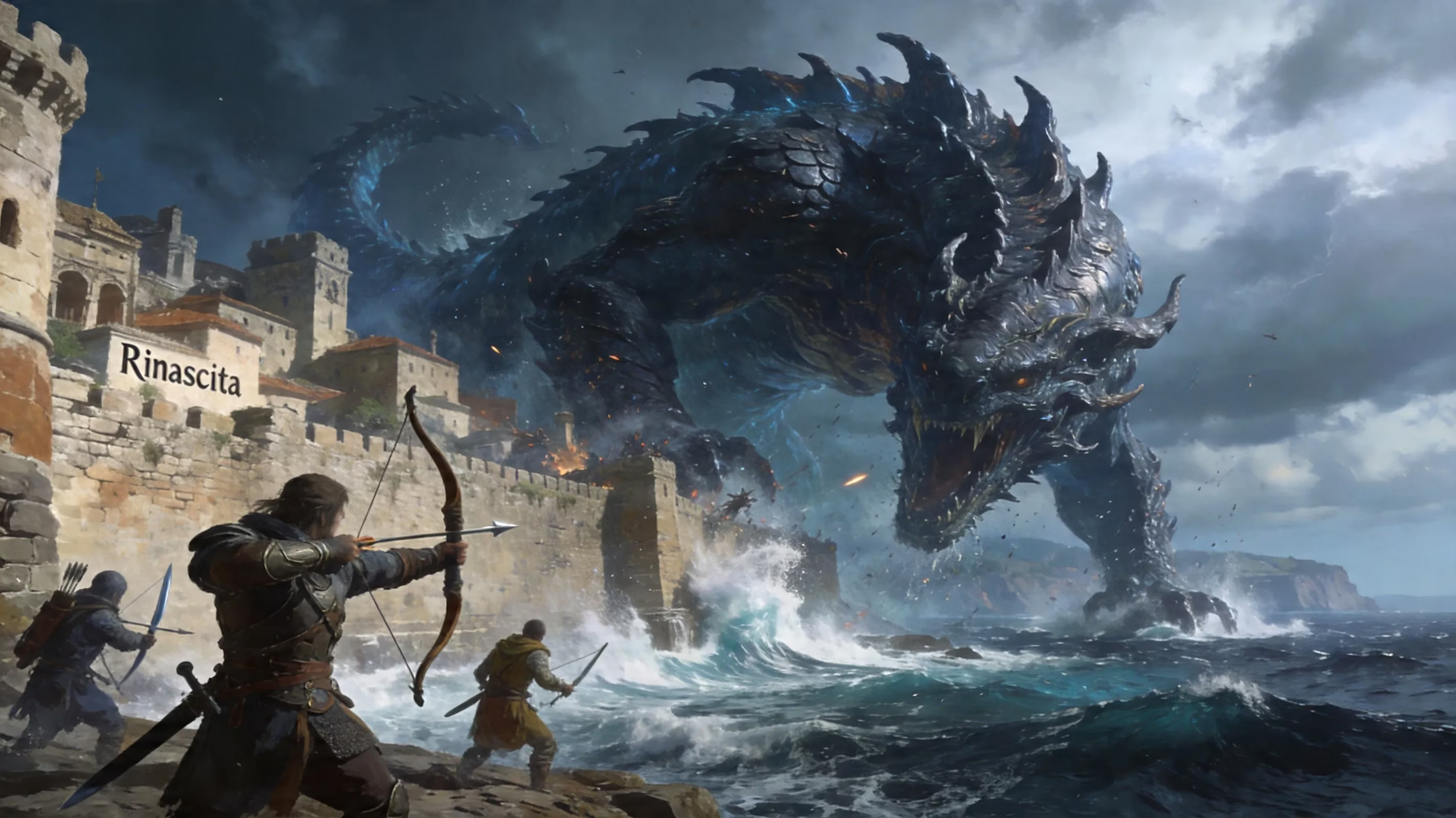
Leviathan embodies the Threnodians’ concept of Unity. Chapter 2 likely contains the most nuanced storyline of the three Threnodians that have been revealed so far. Unlike the brute-force attack that Leviathan launched against Rinascita using sheer physical force, Leviathan undermined the Ragunnesi people's communal identity and faith by corrupting the very basis of their shared religious structure. That nuance is significant. A Threnodian associated with unity will not just eliminate unity altogether; it will give unity a toxic twist, consuming and ultimately destroying it.
When Leviathan returned fully with the Dark Tide after Chapter 2, it almost consumed all of Rinascita and left behind a lore moment of epic proportions as it addressed Abby directly.
Aleph-1
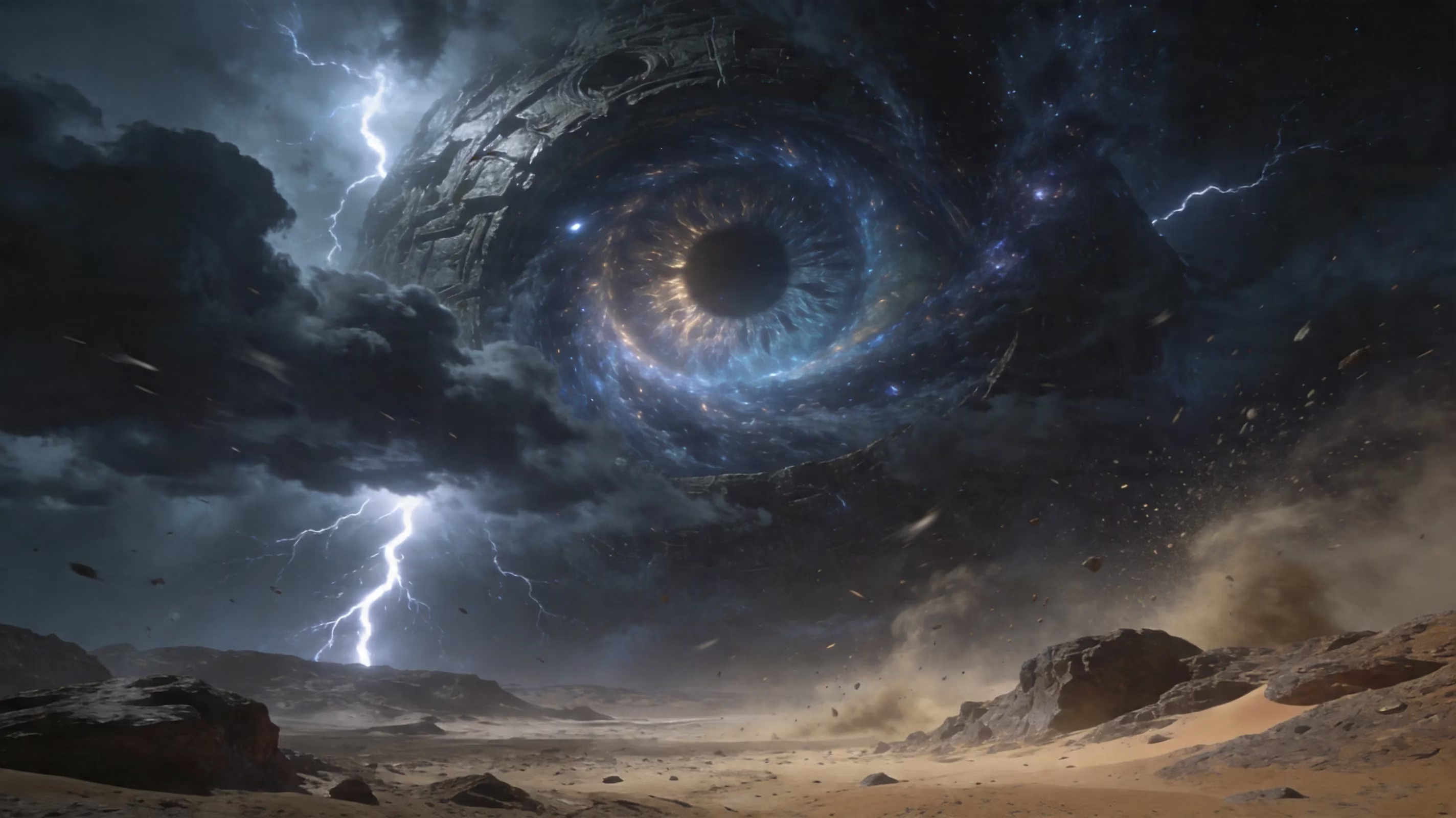
Aleph-1, called Hvedrungr by the Roya tribe, belongs to a different class of Threnodians compared to those we've seen thus far. It represents the Void, specifically erasure and destruction of existence. Aleph-1 is not one of the Threnodians created from an individual's fears on Solaris-III, but rather is an alien being that came to the planet when the Exostrider utilized Stridergates to ferry Sentinels from another civilization. As a result, Aleph-1 is likely the most powerful type of Threnodian found to date, in addition to being extremely distressing because of its outside origin.
The Void Storms currently wreaking havoc across the Lahai-Roi region (through their use for the Voidworm) and associated with Aleph-1, are visually represented by the presence of the cosmic eye of Aleph-1 hovering above Lahai-Roi. Aleph-1 will also likely be responsible for Fractsidus activity occurring at various locations within Lahai-Roi, between Chapters 3.0 - 3.2, as evidenced by the experiments of the Resonators attempting to use its power. The story of Aemeath, which culminates with Version 3.1, ends with her resonance with the Exostrider and their efforts to reseal Aleph-1 within the Stridergate resulting in catastrophic results. The contrast between Threnodians and Sentinels is at the heart of Wuthering Waves’ universe building. While they both operate on an equal amount of raw power, their roles could not be further apart. Sentinels are divine protectors, acting as stabilizers in the different regions of Solaris-III, while Threnodians exist to lead humanity to its own demise.
| Threnodians | Sentinels | |
|---|---|---|
| Origin | Human fears / Void | Ancient civilizations / Deity |
| Purpose | Destroy all life | Save entire regions |
| Power-level | Apex | Apex |
| Faction association | Utilize by Fractsidus | Opposed to Fractsidus |
This is where the Fractsidus becomes extremely dangerous among these entities: they utilize the knowledge that despair, strife and instability awaken Threnodians as a weapon, so they’re not just another faction causing trouble; they are actively being used as accelerants by Fractsidus in creating the very types of catastrophes that Resonators and Sentinels are looking to stop. Their entire civilization-reset ideology isn’t just an act of randomness and insanity; it is structural, purposeful, and presents as a type of necessary theological action. With every Threnodian that stirs, the threats faced will be twofold: the monster itself, and then the humans attempting to direct that disaster into something worse.
The stakes are still extraordinarily high heading into Chapter 3.2. Aleph-1 has been re-sealed, however, Aemeath is still locked inside the Stridergate and the connection that Fractsidus has with erasure power has yet to be resolved. The presence of Fractsidus within Startorch Academy during the 3.2 Main Quest indicates that their operations are growing, rather than regressing.
Abby, Abraxas and Threnodians
Among the many questions surrounding what are the Threnodians and how do they connect to the Wuthering Waves, There are two main unanswered questions: 1) Who or what is Abby? 2) Why does Leviathan look at Abby and call her Abraxas at the conclusion of Chapter 2? At the moment that Leviathan (emphasis added) could no longer defeat/is dying/ceasing to exist, it looked directly at Abby and directly accused her of betraying it. Because Leviathan has just been defeated by the player, it is likely that Leviathan is referring to some prior experience it shared with Abby, but Abby cannot recall having that prior experience with Leviathan.
The significance of that moment is strong; it is not some inconsequential word thrown in that gives texture to the scene. It is a dying Threnodian who accuses another being of betrayal. The game wants the player(s) to remember the moment in the same way they want the players to remember the name Abraxas, which has a clear Esoteric meaning. Players have taken these two forms of evidence and connected them to one another, creating many theories about the possible origin(s) of Abby and Threnodians.
It’s essential to separate canon from theories. To summarize:
- Confirmed: Abby was referred to as "Abraxas" by Leviathan and was considered as someone who had betrayed the Threnodians.
- Not Confirmed: Abby was a former Threnodian, Abby was created by them, or Abraxas is another separate being that is somehow connected.
- Unresolved: Abby’s true origins, her lost memories, and how far back her connection with these beings actually goes.
That uncertainty is driving theory crafting right now around who and what Abby has been because she had been a major mystery since well before the current chapter of the story began.
Further complicating matters are Hiyuki and Denia, who appear to have even more connections to the Threnodians. Hiyuki has some sort of link to Aleph-1, and it will be explored in the 3.2 Segue Quest "Rabbit Reflected in Shades" (because she plays an important role in what seems like a future plot feature). Denia also looks to be visually connected to Aleph-1 through the Threnodian presence in the background of her gameplay showcase. Because of how closely tied these two characters are to Aleph-1's story, one question that will be answered going into version 3.3 and beyond is whether or not either will contribute to our understanding of either Abraxas or Abby and their relationship to the larger Threnodian network.
Conclusion
So, if you really want a quick hit on what Threnodians are in Wuthering Waves, it’s this: They are entities created from humanity’s deepest fears and corrupted concepts, that each embody a twisted version of specific aspects of human experience such as war, unity, or erasure. They are closely associated with the Lament, they create Waveworn-type events, and the level of threat that they provide humanity’s civilization is roughly on par with the Sentinels who oppose them. The three confirmed Threnodians currently are Ovathrax, Leviathan, and Aleph-1, and they are each associated with the central conflict of a major story arc.
As it stands, the bulk of the major lore questions following the conclusion of version 3.2 are still yet to be answered. Abby's relationship to Abraxas, the Fractsidus' intentions with Aleph-1's ability to erase, Aemeath's current game state within the Stridergate, and the possibility of other Threnodians awaking in the unexplored areas of the Wuthering Waves lore are all in flux. As both Hiyuki and Denia are sure to expand the lore related to this portion of the Wuthering Waves universe, the best course of action for you is to pay very careful attention to every new quest and reveal going forward.